ADR-0008: The ledger is the bank's view
Status: Accepted Date: 2026-10-10, accepted 2026-10-11, amended 2026-10-12 (a movement is a signed amount; see Amendment) Stage: ADR-0002 stage 8 (roadmap 1.8), story 1.8.2a, before 1.8.2 completes (renumbered 2026-10-11: 1.8.2 and 1.8.3)
Context
go-luca's balance is money in less money out, and a movement moves an
amount from one account to another. The bank posts a deposit from
Equity:Capital to the customer's savings account, so a savings balance
is positive, like a loan's; interest applied to savings posts from
Expense:Interest to the account, so the expense runs negative; a loan
drawdown posts from equity too, so equity runs negative.
This is the crux. A worked month as the bank writes it today, drawn by pta2svg from 0008-today.goluca: Alice deposits £1,000, Bob draws an £800 loan, and at the month end 1.5% and 6.9% are applied. Each node carries the balance it is left with, computed from the movements as go-luca computes it.

The chart is signed by the direction each event happened to be written in, not by what the accounts are. Every read, from the book to the balance sheet to the P&L, carries a sign correction for it.
The product contract (ADR-0006, gobank-products v0.6.0) is written in the bank's view: a savings balance is a liability and negative, a loan an asset and positive, and the term, allowance and overdraft rules read a movement's direction that way. The same month in that view (0008-decided.goluca), with cash where equity was:
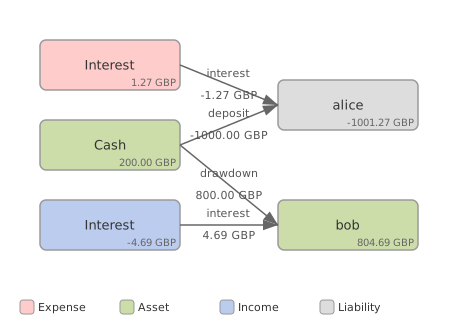
Integrating the contract (story 1.8.2, now 1.8.3) the ISA counted every deposit as a withdrawal. Two conventions met, and one has to go. For the view itself, double entry as a directed graph with debit and credit as nothing more than positive and negative, see Accounting for Programmers (bytestone.uk/afp).
Decision
All contracts and code are written from the bank's view; presentation may vary. The ledger, the sub-ledger and the general ledger alike, holds the bank's view: debit-normal accounts (assets, expenses) carry positive balances, credit-normal accounts (liabilities, equity, income) negative.
A movement is an amount m from account a to account b: b's balance
rises by m and a's falls by m, go-luca's semantics unchanged. m is
signed, positive or negative, and the ledger keeps it as it was
written: nothing turns a negative movement about. The bank writes every
movement from the counterparty to the account the event is about, with
m the change to that account's balance in the bank's view. So interest
on a savings account is a negative m from Expense:Interest to the
account, and interest on a loan a positive m from Income:Interest to
the loan. Savings interest is an expense and lending interest income;
read against the risk-free rate both are income, a net interest margin,
which is a later reading and not a posting. Credit and debit are not
the ledger's words: the directed-graph approach of Accounting for
Programmers has them as nothing more than the sign of a balance, and
a reader who wants them takes them from the movement (a positive m
credits a and debits b; a negative m the other way). Engineers read
and write in this view; the customer's view, in which both savings and
loans are positive, is presentation and switchable.
| Account | Normal | Sign in the ledger | Holds |
|---|---|---|---|
Asset:Cash (new) |
debit | + | the bank's cash from customer flows: deposits in, drawdowns out |
Asset:Loans:<customer>:<product> |
debit | + | what a borrower owes |
Asset:BoEReserves, Asset:AccruedInterest:BoE |
debit | + | unchanged |
Liability:Savings:<customer>:<product> |
credit | − | what the bank owes a saver |
Equity:Capital |
credit | − | the bank's capital; no longer the counterparty of customer flows |
Income:Interest, Income:Interest:BoE |
credit | − | unchanged |
Expense:Interest |
debit | + | was negative |
Posting directions
Every movement runs from the counterparty (a) to the account the event is about (b), and m is b's change in the bank's view.
| Event | From (a) | To (b) | m | Effect |
|---|---|---|---|---|
| Deposit, savings funding | Asset:Cash |
the savings account | −amount | savings more negative, cash up |
| Withdrawal to the outside | Asset:Cash |
the savings account | +amount | savings less negative, cash down |
| Transfer, A pays B | A's account | B's account | −amount | A less negative, B more |
| Loan drawdown | Asset:Cash |
the loan account | +amount | loans up, cash down |
| Loan repayment | Asset:Cash |
the loan account | −amount | loans down, cash up |
| Savings interest applied | Expense:Interest |
the savings account | −interest | the contract's posting as written: the expense rises, savings more negative |
| Loan interest applied | Income:Interest |
the loan account | +interest | income more negative, the loan up |
| BoE reserve interest | Income:Interest:BoE |
Asset:AccruedInterest:BoE |
+interest | unchanged |
| GL: control movements and the journal | the same, with Asset:Cash on the GL's chart and the product's control for the account |
The ledger wrapper's parameters are from, to and amount, as
go-luca's are; the sign is the caller's to write, and the wrapper
records what it is given.
The two diagrams in the context are these directions, today's and the decided, over one worked month.
Reads
| Read | Today | Decided |
|---|---|---|
| The book: savings | the sum of savings positions | the negated sum |
| Funds for a transfer | balance ≥ amount | the negated balance ≥ amount |
| Interest expense to date | the negated expense balance | the expense balance |
| A statement's running balance | in less out, positive | in less out, negative for savings; presented per view |
| Cash | savings less lending, computed | the Asset:Cash balance, read; the balance sheet balances from the ledger once 1.6a.3 moves it there |
| The history's daily savings and lending | magnitudes | magnitudes, unchanged: a chart series, not a ledger balance |
Presentation
| Where | View | Default | Settable |
|---|---|---|---|
The core's API (core.Account.Balance and every figure) |
the bank's | no: the API speaks accounting | |
| The staff web | bank's or customer's | the bank's: engineers and staff work in the accounting view | per signed-in session, a switch in the layout |
| The customer app | the customer's: savings and loans both positive | no | |
| The customer app's position with the bank | the bank's view negated: what the bank owes the customer net of what the customer owes, signed | shown as a total |
The movement beneath the statement line
A statement line is a presentation of one movement from one account's side. Beneath it the bank shows the movement itself: the account it is from and the account it is to, each with its type and the balance it was left with, the signed amount, the value time and the knowledge time, the code and the description, and for a rule posting the record ADR-0006 keeps beside it (the version, the event, the parameters read and the position applied). Drawn as the directed graph of Accounting for Programmers (bytestone.uk/afp): two nodes carrying their balances, one arrow carrying the amount, coloured by account type. Every statement line on the staff web links to it; the app follows.
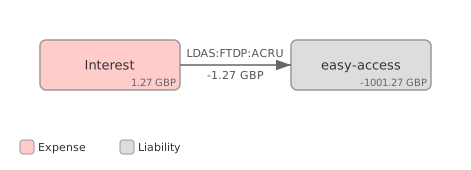
The renderer is pta2svg, the same tool that drew this ADR: the movement is handed over as pta2svg's model, the ledger as data, so no text is parsed, and drawn where it is shown; the goluca text, the ledger's own export format, is shown and served beside it. On the staff web and the customer web the drawing is pta2svg's lite WASM build (0.7 MB under TinyGo, against 24 MB with the text parsers) rendering the model embedded in the page, the first rendering a general client takes on from the BFF; the Flutter app reaches it through a web view or is left with the data until it has a renderer of its own. The core gains a query for one movement by its ID, with both legs, and the BFF serves it as the page, as goluca text and as data.
What pta2svg needs for this, as of v0.1.6, raised as its issues: a
public library package, its parser, layout and renderer being internal
today (#5); a WASM
build (#6); opening
balances, so that a single movement is drawn with the balances the
accounts are left with rather than the movement's own net
(#4); names with
spaces, which d2 takes in its stride, for the labels a page shows
(#3); and two faults:
the goluca parser yields an empty diagram where the pta parser reads the
same text, which is why the files here are rendered with -format pta
(#1), and a hyphen in
an account path (easy-access) empties the diagram, so the movement
above spells the product without one
(#2).
Running banks
A running bank holds its history in today's signs, and the ledger is append-only. The demo's data is synthetic, so rather than rewrite its history the current runs are abandoned: preprod and prod are reset and start again on this release. The drill for this story is therefore a fresh deploy, not an upgrade in place, named as the exception to ADR-0003 that it is: the rollback step does not apply, and the record says why. A fresh database needs no conversion. A real bank would need the conversion this ADR does not write; its shape is known (reverse every movement with a savings account on a side, move funding counterparties from equity to cash, negate the savings positions and controls, recompute cash and equity) and it stays unwritten until a bank with history that matters needs it.
Choices made, and the alternative to each
| Choice | Alternative | Why this one |
|---|---|---|
| The accounting view in the ledger | positive in the account's own sense | the ledger is the bank's; a liability is a credit; the contract already says so; every sign correction in the reads goes |
| A sign the contract legislates | a sign the rule reads from the runner | two conventions in one system is the problem, not something to abstract over |
| A movement keeps its sign | a positive amount from the account credited to the account debited, the direction carrying the sign (as first accepted) | the contract writes a signed amount to the account; turning it about made the ledger and the page disagree with the contract, and put credit and debit back into the vocabulary |
Asset:Cash as the counterparty of customer flows |
equity, as today | a deposit is not capital; cash is what the balance sheet is missing |
| Presentation converts; the core does not | a view parameter on the core's queries | one API, one truth; a view is a rendering |
| Reset preprod and prod | convert the stored history once | the data is synthetic and the conversion is a history-rewriting migration nobody needs yet; its shape is recorded for the bank that will |
Consequences
Easier: the contract runs as released; the balance sheet can be read from the ledger; the GL reconciles signed sums without special cases; an engineer reading a movement reads the contract's posting as it was written, and the movement page draws it so.
Harder: the first story whose drill is a reset rather than an upgrade in place; every place that shows a balance decides its view; the demo books no capital yet, so equity reads zero until it does.
Given up: the simple confusion of positive numbers everywhere. Debt reads as what it is, and the customer gets the positive view back in the app.
Amendment, 2026-10-12
As first accepted the decision read "a movement is from the account
credited to the account debited", and the runner and the ledger wrapper
read it literally: a contract posting with a negative amount was turned
about and recorded as a positive amount the other way, so the movement
page showed savings interest as £1.27 from the account to
Expense:Interest. The decision now says what was meant: a movement is
a signed amount from a to b and the ledger keeps it as written. The
posting-directions table, the decided and movement diagrams and the
wrapper's parameter names follow. The running banks are reset again on
the release that carries it, the drill a fresh deploy as in 1.8.2.